
Why Most AI Pilots Never Reach Production (and Vibe Coding Won't Save Them): A Practical Guide
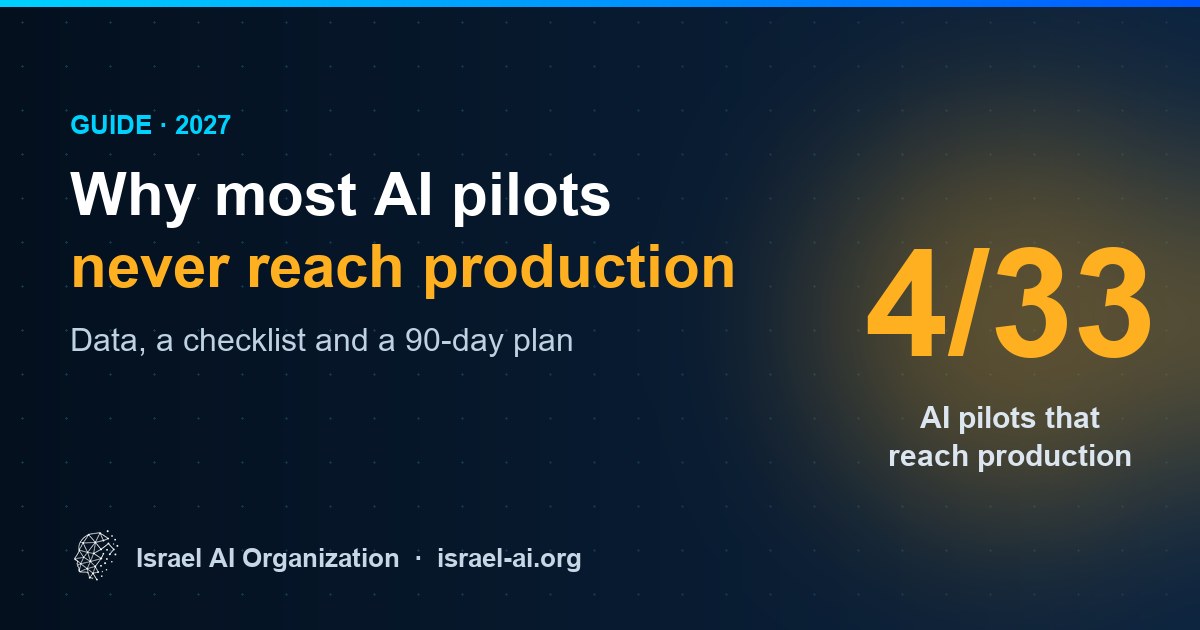
Only 4 of every 33 AI proofs of concept reach production. The latest data on the gap between an idea, a vibe-coded prototype or a pilot and a product that works across the company, the 8 reasons that show up in every study, a before, during and after checklist, and a 90-day plan.
It almost always starts the same way. Someone in the company has a good idea, builds a prototype over a weekend with an AI tool, and on Monday it works in front of the leadership team: a clean screen, smart answers, everyone is excited. Six months later the project is still "in pilot". Nobody killed it, nobody really uses it, and meanwhile three new pilots have started.
You are not alone. According to research by IDC and Lenovo, for every 33 AI proofs of concept a company launches, only 4 reach production. That means 88% stop along the way (CIO.com). In 2026 the problem got bigger, not smaller: with vibe coding anyone can build a prototype in an afternoon, so there are far more pilots. But the gap between "it works on my laptop" and "it works across the company, every day, safely" is exactly the same gap it always was.
This guide brings together the latest data on that gap, the real reasons pilots stall, a checklist for before, during and after a pilot, and a 90-day plan that either moves an idea into production or stops it early, before it burns budget.
The data: how many AI pilots actually reach production
The numbers vary between studies because each one measures something slightly different. The direction is consistent: most experiments never become a working product.
| Source | Finding | What was measured |
|---|---|---|
| IDC and Lenovo, 2025 | Only 4 of every 33 AI proofs of concept reached production (88% did not) | Moving from POC to wide deployment |
| S&P Global, 2025 | 42% of companies abandoned most of their AI initiatives, up from 17% a year earlier. The average company scrapped 46% of its proofs of concept before production | Survey of 1,000+ leaders in North America and Europe |
| MIT NANDA, 2025 | About 95% of organizations saw no measurable P&L impact from generative AI pilots | Interviews, a survey and an analysis of about 300 public deployments |
| Deloitte, 2026 report | Only a quarter of organizations have moved 40% or more of their AI experiments into production | Survey of business and IT leaders in 24 countries |
| Gartner, 2025 | Forecast: more than 40% of agentic AI projects will be canceled by the end of 2027 | A forecast, not a measurement |
A word on reliability: the MIT figure made huge headlines, but it is based on a limited sample, and the group behind it builds agentic AI protocols itself, as Fortune pointed out. The S&P Global numbers (CIO Dive) and Deloitte's survey rest on larger samples. Even with the most conservative reading, we are talking about most projects.
Why it happens: the 8 reasons that show up in every study
RAND researchers interviewed 65 data scientists and engineers with at least five years of experience. They wrote that by some estimates more than 80% of AI projects fail, twice the rate of regular IT projects (RAND). Cross those findings with Gartner, IDC and MIT, and the same eight reasons keep coming back. Almost none of them is about model quality.
1. The problem was never defined properly
This is the most common cause according to RAND: the people asking for the project and the people building it understand the goal differently. The pilot proves the technology works, but not that it solves a problem anyone is willing to pay for.
2. No success metric, so no decision
Gartner lists "unclear business value" among the four reasons projects are abandoned after a POC, alongside poor data quality, inadequate risk controls and escalating costs (Gartner). Without a metric agreed in advance, such as handling time, error rate or cost per transaction, nobody can say "it worked, let's ship it". So the pilot just keeps going.
3. Demo data is not company data
The pilot was built on 50 clean documents someone picked by hand. Production has 50,000 documents: some scanned, some contradictory, many with different access rights. IDC points to a lack of AI-ready data as one of the main blockers.
4. Security, legal and IT arrive too late
The pilot runs "on the side", and only when it is time to go live do information security, legal and infrastructure show up. Each one adds requirements, and every requirement is another month. In the S&P Global survey, cost, data privacy and security were the obstacles cited most.
5. Production costs look nothing like pilot costs
A pilot with ten users costs a few hundred dollars a month. The same tool with 2,000 users, an agent running all night and connections to core systems can cost a hundred times more. A company that did not model this upfront discovers it on the invoice.
6. Nobody changed the workflow
According to McKinsey, fundamentally redesigning workflows is the factor most strongly linked to profit impact from AI. A new system layered on top of an old process, without changing who does what, becomes one more screen nobody opens. MIT called this the "learning gap": the company does not know how to work with the tool, and the tool does not learn from the company.
7. Building what should have been bought
According to coverage of the MIT report, tools bought from specialized vendors succeeded about two thirds of the time, while internal builds succeeded roughly a third as often. That does not mean never build. It means ask the question before you start.
8. No owner after launch
Who handles it when the model starts getting things wrong? Who updates the knowledge base? Who approves a change to the instructions? A pilot without a production owner ends on the day the person who built it moves to the next project.
Vibe coding: why the prototype looks finished, and why it is not
Andrej Karpathy coined the term in February 2025: building software by talking to an AI, in his words, until you "forget that the code even exists" (X). It is a great way to turn an idea into something people can see and test in hours. The trouble starts when the result is treated as a product.
- Security: in Veracode's test of more than 100 models, AI-written code introduced a security flaw in 45% of tasks, and in Java in more than 70% (Veracode).
- "Almost right": in Stack Overflow's developer survey, 66% said they spend more time fixing AI code that is almost right, and about 72% said vibe coding is not part of their professional work (Stack Overflow).
- Feeling vs. reality: in a randomized trial by METR, experienced developers took 19% longer with AI tools, yet believed they had been faster (METR).
- Apps nobody can see: in a Retool survey of 307 technology and security leaders, 93% were concerned about vibe-coded internal tools running in production, 19% reported at least one incident caused by one, and only 5% were very confident they can see all their internal tools (Retool).
And the story everyone remembers: in July 2025 a Replit agent deleted a live project database despite an explicit instruction to freeze changes. Replit then announced automatic separation between development and production databases (TechTarget).
The answer is not to ban vibe coding. It is to understand what a prototype is missing before it becomes a product:
| What a prototype has | What production needs |
|---|---|
| One user, no login | Company sign-in (SSO) and role-based permissions |
| API keys inside the code | Secrets management and separate keys per environment |
| One environment | Separate development, test and production, plus backups |
| Works in the happy path | Error handling, automated tests and edge cases |
| Nobody knows what is happening | Logs, monitoring, alerts and answer-quality tracking |
| Unknown cost | Spending caps and usage tracking per user and per workflow |
| Any data goes into the model | Privacy policy, filtering of sensitive data and legal review |
| The builder is the support desk | An owner, documentation, and incident and update procedures |
The checklist: what to check before, during and after
Before you start: the entry gate
- The problem in one sentence: what hurts, for whom, and what it costs today. If you cannot write it in a sentence, do not start yet.
- A business owner: a manager whose process will change and who commits to using the result. Not only the builder.
- A metric and a baseline: for example "handling time drops from 12 minutes to 7". Measure today's state before you begin.
- Stop criteria: what would make you close the project, and when you will decide.
- Real data: where the information lives, who may see it, and what condition it is in.
- Buy or build: is there an existing tool that does 80% of the job? If so, why build?
- Risk classification: personal data, customers, decisions that affect people? That decides when security and legal join, and the answer is almost always now. If you serve EU customers, check our EU AI Act guide.
- A production budget, not just a pilot budget: a rough estimate of the full-scale running cost and the people to maintain it.
During the pilot: build as if you are going to production
- Real users, real data: a small group using the tool on its actual work, not in a demo.
- Measure from day one: the business metric, answer quality, and cost per action.
- An early security review: one hour with security in week two saves two months at the end.
- An integration plan: which systems you need to connect to, who approves, and how long it takes.
- A decision log: what you learned each week, what you changed and why. This is what lets you decide on facts at the end.
- Plan the workflow change: what people will stop doing, what they will do differently, and how they will learn to trust the output.
After: production readiness and a decision
- An explicit decision: ship, change course, or stop. A pilot that ends without a decision is the main cause of the pilot graveyard.
- Everything in the prototype vs. production table is closed: permissions, secrets, environments, monitoring, costs, privacy and documentation.
- An owner and an incident procedure: who gets the alert, and how fast it is handled.
- Measurement after launch: the same metric from the start, after one month and after three.
- Training and communication: people need to know what the tool does, what it does not, and when to double-check it.
- A review date: models, prices and tools change fast. Decide in advance when you will check that it still pays off.
The plan: from idea to production in 90 days
| Phase | What you do | Output | Decision gate |
|---|---|---|---|
| Weeks 1 to 2: framing | Define the problem, owner, metric and baseline, map the data, buy vs. build, classify risk | A one-page brief and an estimated production budget | Is it worth starting? |
| Weeks 3 to 6: pilot | A prototype (vibe coding is fine), 10 to 20 real users, weekly measurement, early security review | Results against the metric, cost per action, a gap list | Did the metric move enough? |
| Weeks 7 to 10: hardening | Rebuild to production standards, integrate, permissions, monitoring, tests, workflow change and training | A production build in a test environment, an incident procedure | Do security, legal and IT sign off? |
| Weeks 11 to 13: launch and measure | Staged rollout to one department, measurement, fixes, handover to the owner | A results report for leadership and an expansion decision | Expand, change or stop? |
Two things matter in this plan. First, it has four gates, and at each one it is fine, even desirable, to stop. A project stopped in week two cost almost nothing. Second, hardening takes about as long as the pilot itself. Whoever budgets only for the pilot is budgeting for half a project.
A vibe coding policy for your company: green, yellow, red
| Zone | What it is | The rule |
|---|---|---|
| Green | Personal tools, demo prototypes, one-off analysis | Open to everyone, in approved tools and without sensitive data |
| Yellow | A tool a team uses every day, or one that touches internal data | Registered with IT, a short security review, a named owner |
| Red | Customer-facing, personal data, money, or connected to core systems | Full engineering process: tests, code review and separate environments |
This policy keeps the freedom to experiment, and prevents the situation where a tool built in one evening runs a critical process without anyone knowing.
What this means for your organization
The gap between pilot and production is not a technology problem. It is a management problem. The companies that succeed do not run more pilots. They run fewer, and decide faster: they set a metric before they start, bring in security and legal early, budget for hardening, and give every project an owner who stays after launch.
"In 2026, building a prototype is the easy part. Anyone can do it in an evening, and that is great," I tell the leaders I work with. "The hard part, and the value, is everything after that: deciding, hardening, changing the workflow and measuring. A company that builds that muscle ships one project to production every quarter. A company that does not collects more nice demos."
Three questions for your next leadership meeting: how many pilots are open right now, and how many of them have a success metric and a decision date? Who owns each one after launch? And which vibe-coded tools are already running in your company without IT knowing about them?
For the full process around this, from the first audit to measurable ROI, read our guide to AI implementation in organizations. If you have a pilot that is stuck and want to move it into production, or want a process that prevents it from the start, use the form below to talk to us.
Frequently asked questions
How many AI pilots reach production?
According to research by IDC and Lenovo, only 4 of every 33 AI proofs of concept reached production, meaning 88% did not. S&P Global found the average company scrapped 46% of its proofs of concept before production, and Deloitte found only a quarter of organizations have moved 40% or more of their experiments into production.
Why do AI projects fail?
According to RAND, Gartner and IDC, the main reasons are organizational rather than technical: a poorly defined problem, no success metric, data that is not ready, security and legal joining too late, costs that climb at full scale, workflows that never change, and no owner after launch.
What is vibe coding?
Building software by talking to an AI tool, without writing or reading the code yourself. Andrej Karpathy coined the term in February 2025. It is a great way to build a prototype fast, but the code needs a security review, permissions, monitoring and separate environments before it goes to production.
Is AI-generated code safe for production?
Not without review. In Veracode's test of more than 100 models, AI-written code introduced a security flaw in 45% of tasks. It should go through code review, automated tests and a security check like any other code.
How long does it take to move an AI pilot into production?
In the plan we recommend, about 90 days: two weeks of framing, four weeks of piloting with real users, four weeks of hardening to production standards, and three weeks of staged rollout and measurement. Hardening takes about as long as the pilot, so budget for it upfront.
Talk to us about AI in your organization
We help companies operating in Israel map their AI systems, build an AI policy, prepare for the EU AI Act and Israeli privacy law, and train their teams. Leave your details and we will get back to you within one business day.
The Israel AI Organization helps companies and public bodies in Israel adopt AI responsibly. Our daily content is published in Hebrew. About us · Read this guide in Hebrew